
A data visualization project for Parsons School of Design
in partnership with the Metropolitan Museum of Art
Douglas Locke
December 2019
|
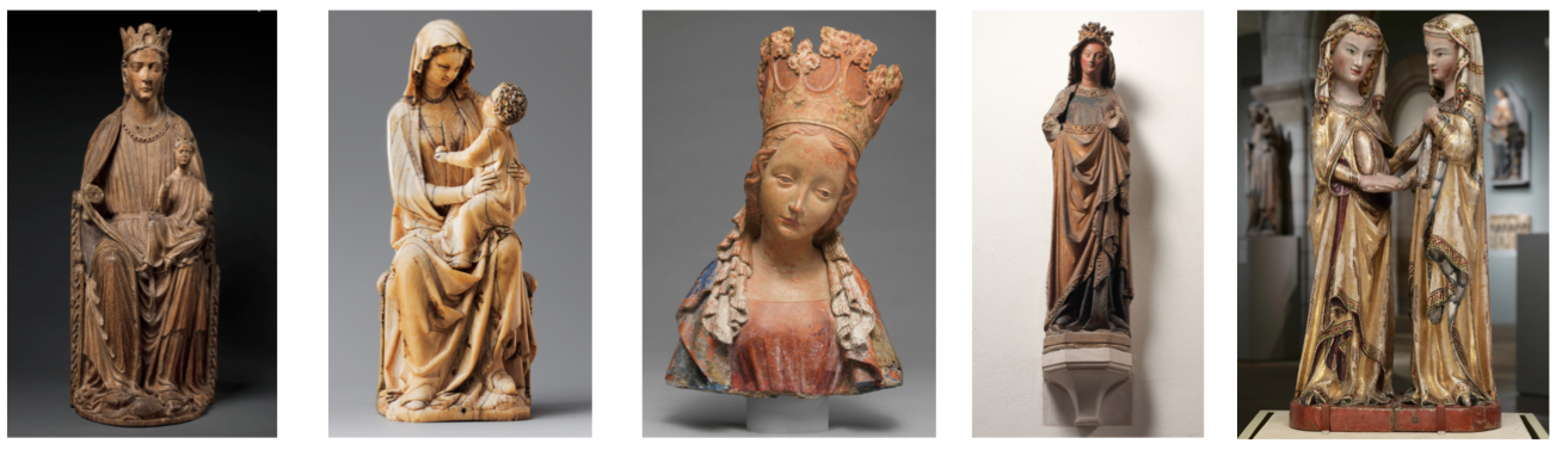
I am interested in forms of Christian art, and the Metropolitan Museum collection is rich and deep in this area. In fact, the Met's collection is so deep, it can be overwhelming to a casual observer, and especially to one without background in Christian thought and perspective. In the image above we see various sculptures of Mary, mother of Jesus. She is sometimes presented alone, sometimes with Jesus as child, sometimes with crown, and in the final picture, she is shown meeting another woman. But what exactly is going on here? I also felt much of this sacred art is removed from its original context. Many of the Met's objects have been presented in Cathedrals, and some even adorned high altars, making many of them central to Christian worship. I wanted to see if using the Met's digital collection I could present the artwork within a narrative framework, and restore the potential for these items to be used as meditative aids. The Rosary was the perfect vehicle; it provides both narrative a prayer context, and it has been used for centuries, including in our present day. Many people at least aware or heard of a Rosary, even if they do not fully understand what it is or how it works. Thus a third goal is established; to relate the art to a devotional practice in current use. |
|
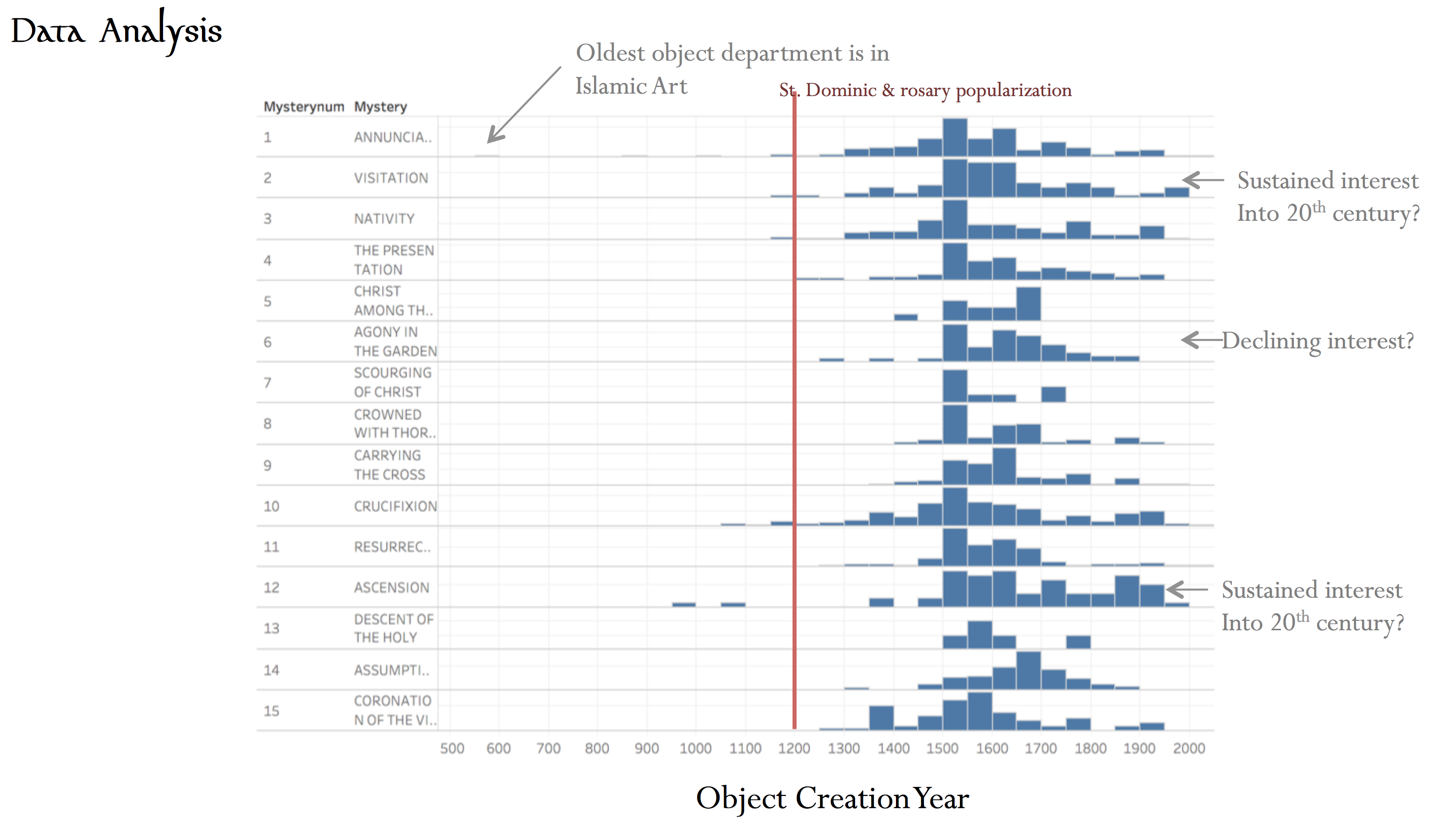
The Metropolitan Museum of Art provides both a text based database as well as an on-line API to search the digital collection. I primarily focused on using the text based database to query, filter and research the objects I would bring into my analysis. I filtered my data set to about 2,000 objects that could be directly related to a Rosary mystery. In the view below, I was interested in understanding when these objects were created. |
|
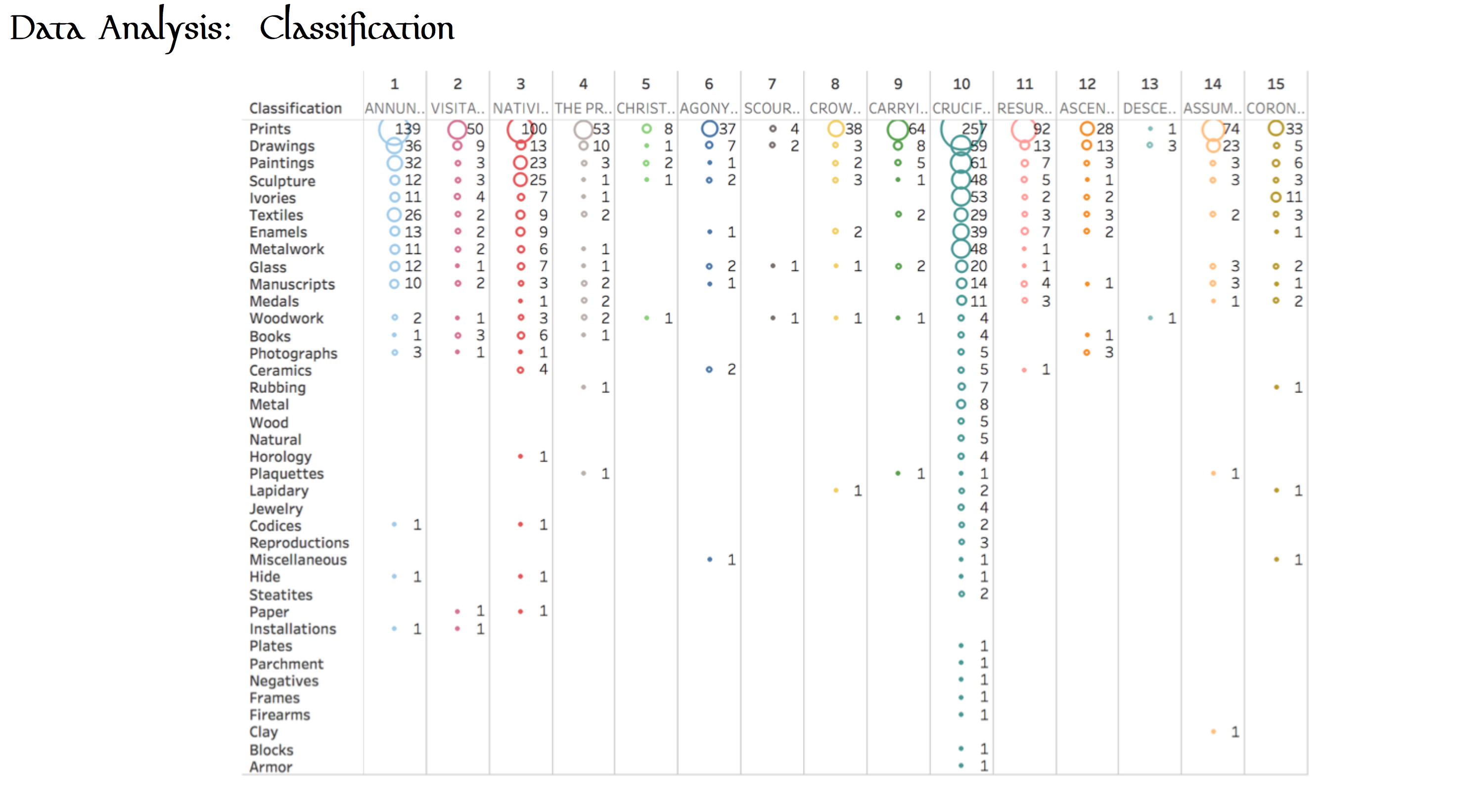
I was also interested in what materials were used. Certainly the collection is dominated by prints & drawings, but overall there is both a lot of diversity and depth in the materials used. |
|
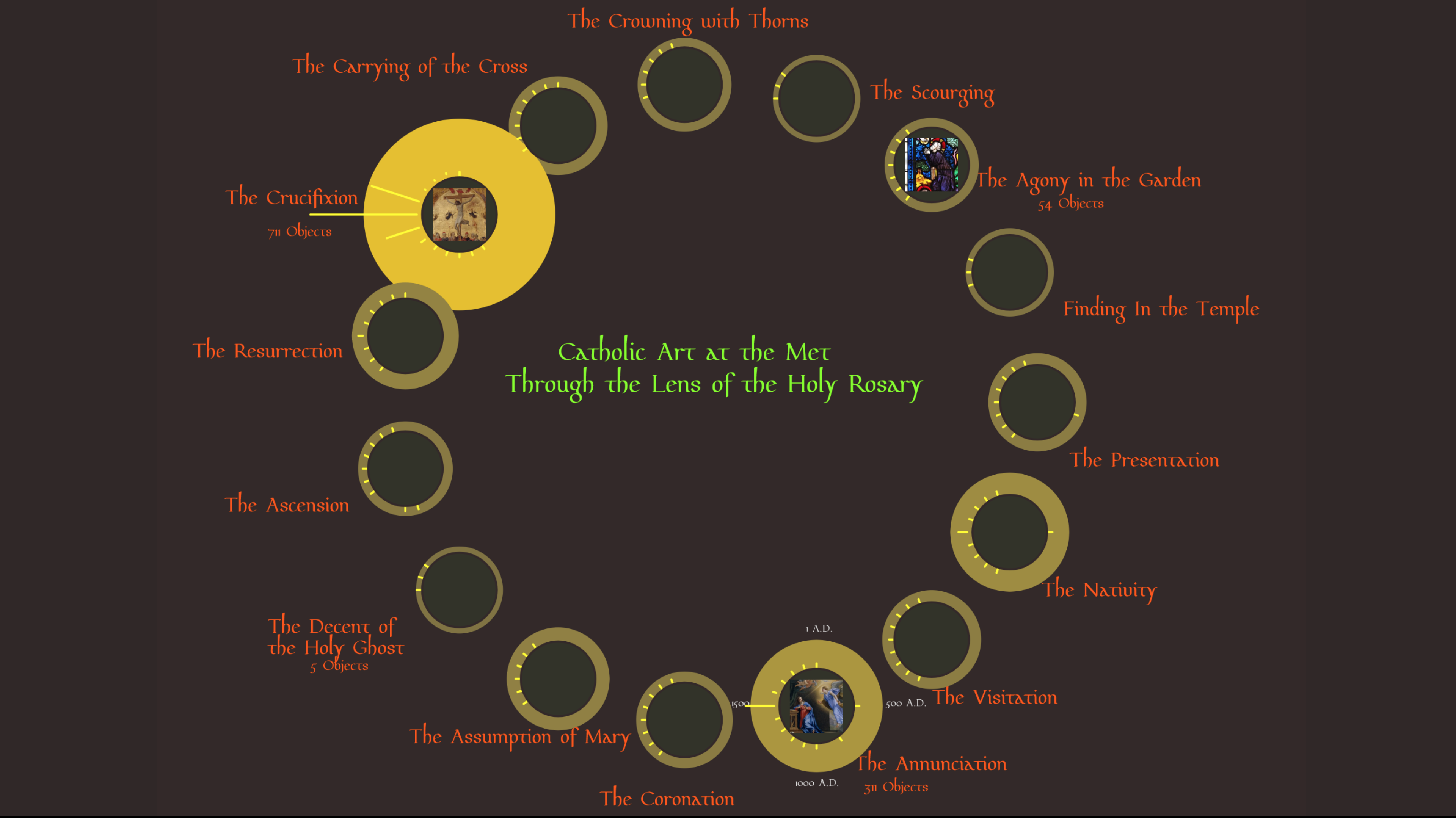
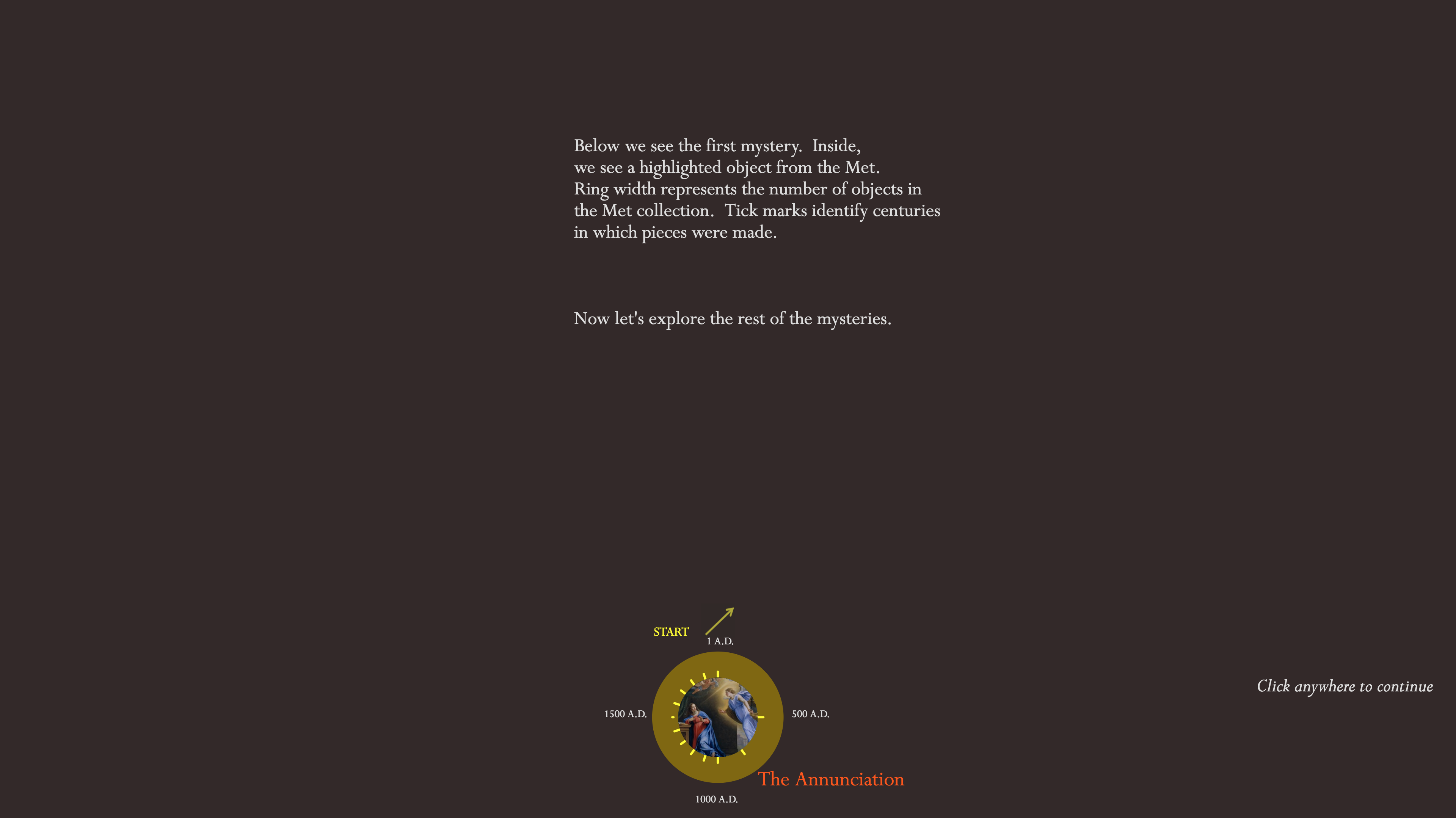
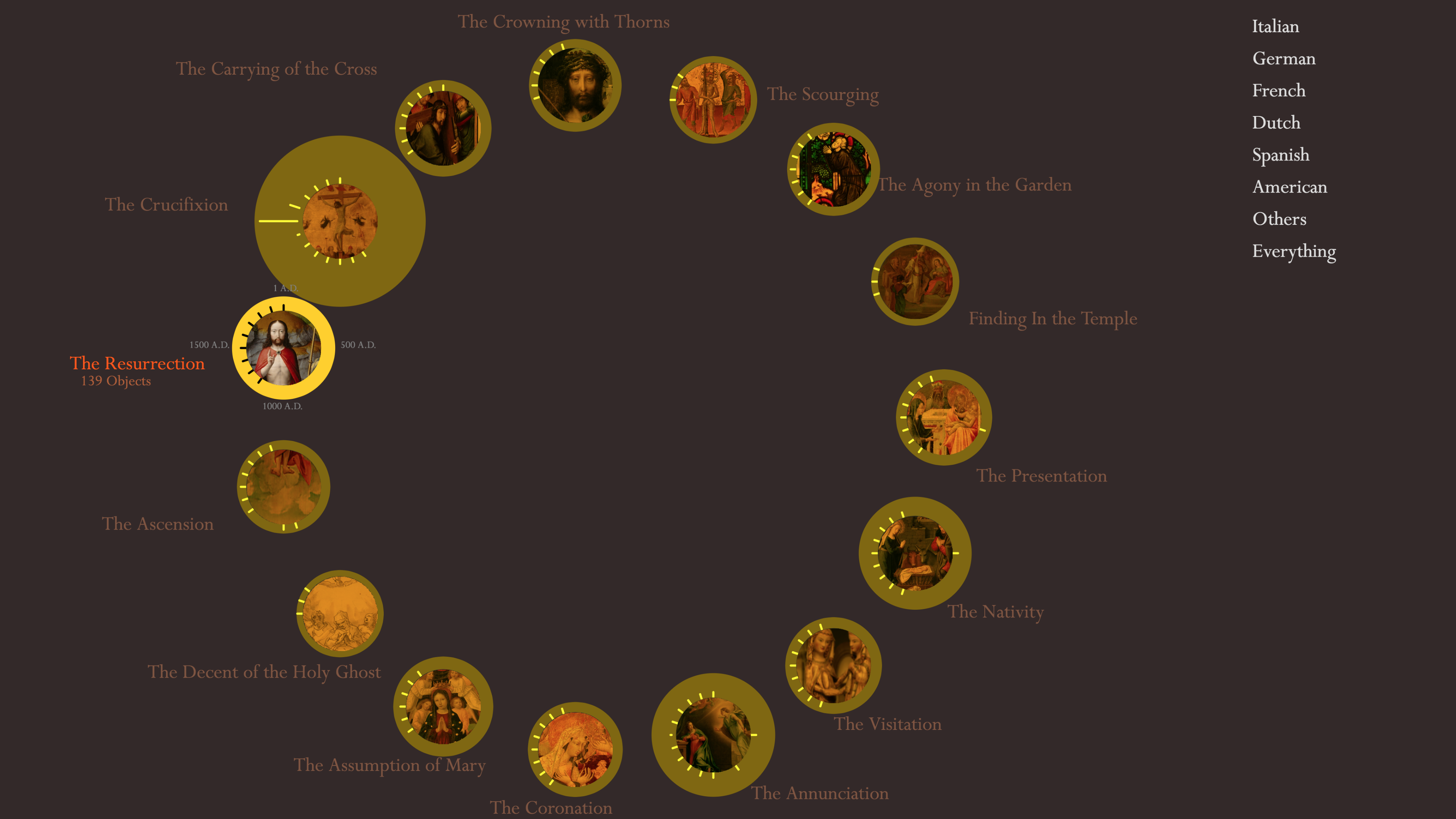
For the quantitative phase, I identified how many Met museum objects can be related with each rosary mystery. The size of each mystery ring corresponds to the number of objects found. Thus the most objects were found related to the crucifixion. I was happy to see all rosary mysteries represented. One question that came up is why so few objects are related to the Nativity (Christmas). This is because there are a large number of objects related to "Adoration of the Magi", but did not include these under the Nativity. Perhaps it would be interesting to show those in some way. The tick marks around the circle correspond to the centuries when the art is produced. The oldest art work was ca. 500 A.D. There are several 20th century pieces, such as Salvador Dali's "The Crucifixion". I tried to avoid a separate legend, instead placing a centuries legend around the Annunciation. Including art in within the ring was a late addition. I would revisit this later. |
|
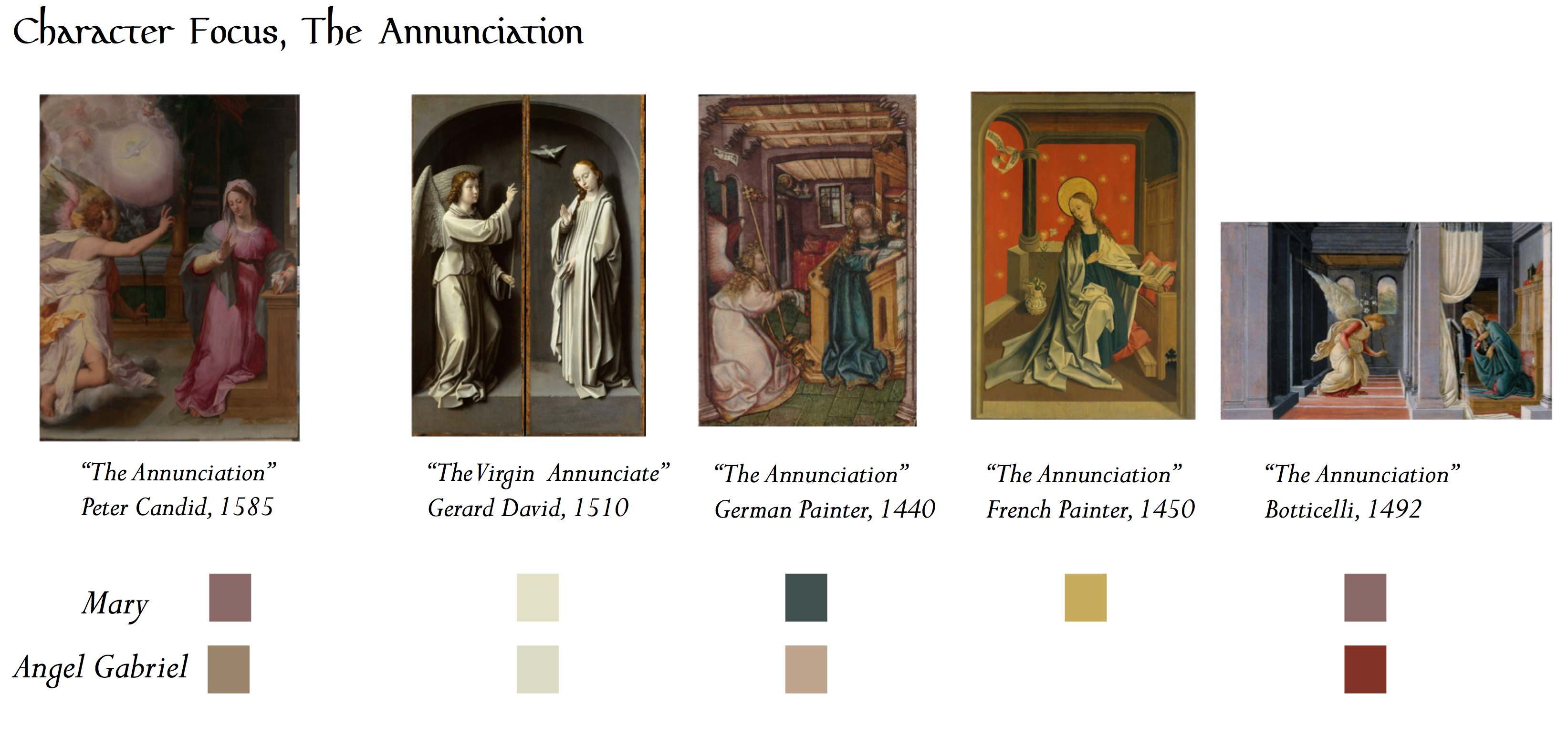
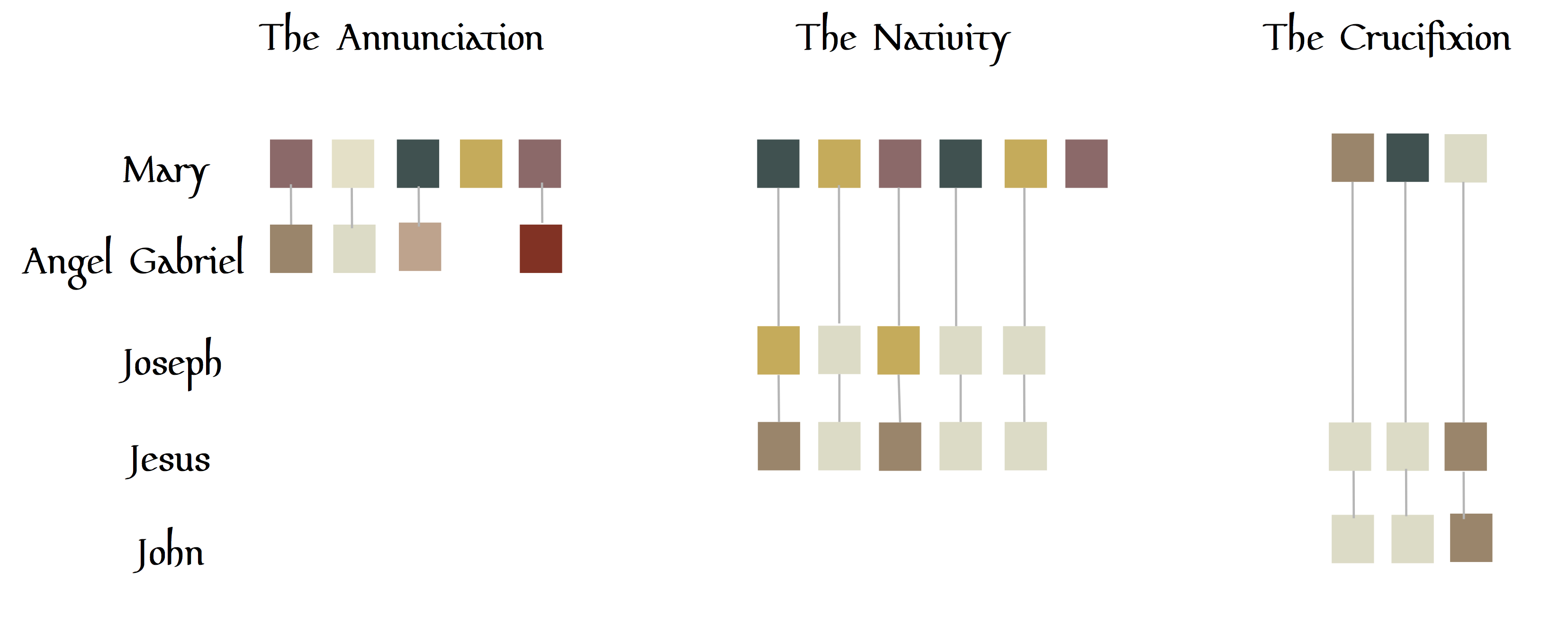
The next phase of the project was to focus on qualitative aspects of the Met collection. I chose to focus only the paintings available in the Met collection that related to a rosary mystery. The qualitative aspect I chose to study was color. I used a color analysis toolkit to extract color palettes from the Met's digital collection. One of the early concepts was to take a single mystery, and analyze color across various paintings, focusing on colors associated with each character. |
|
Another concept simply chose the dominant colors for each mystery, and play them in an animated sequence. |
|
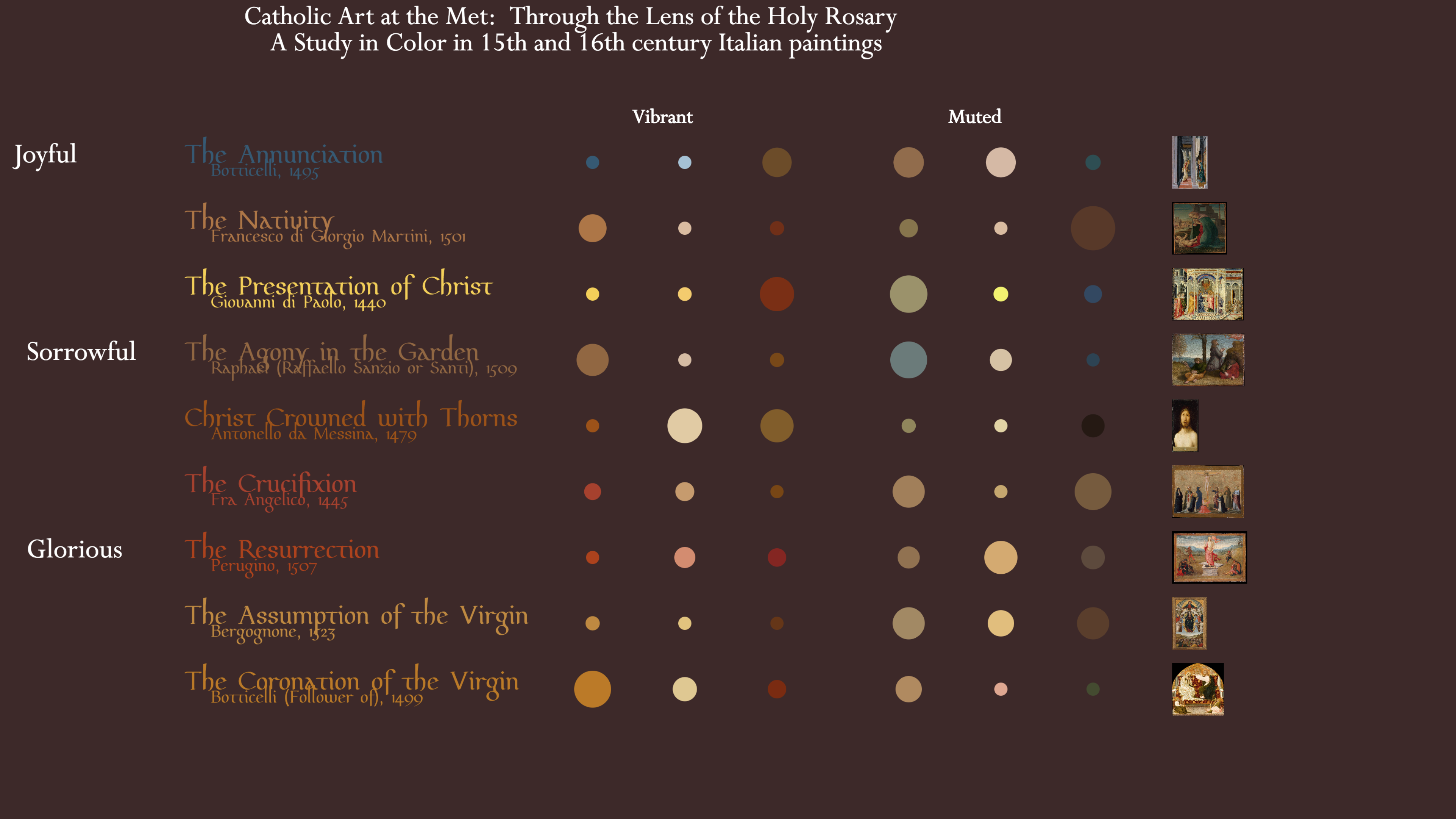
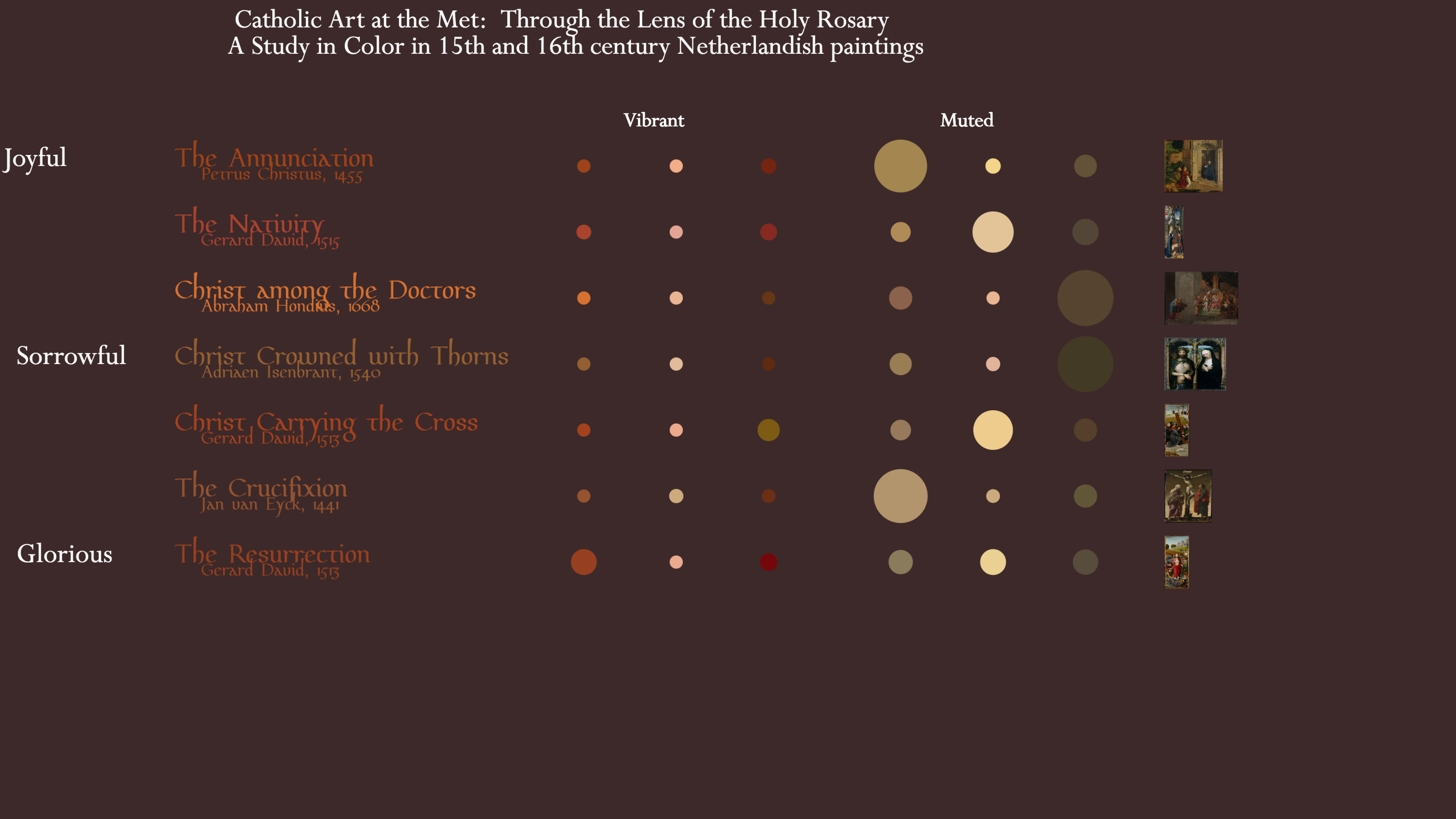
The final concept was to show color palettes contrasting paintings across Italian and Netherlandish painters. I expected the Netherlandish painters to show a greater diversity of vibrant colors, but in reality the Italian painters seemed to show more diversity of colors. The Netherlandish paintings seemed to be dominated by muted beiges. This may be an effect of the paintings I chose. Circle size represents the amount of the color used in the paintings. I was not aiming for precision, but rather to have a general sense of color analysis. |
|
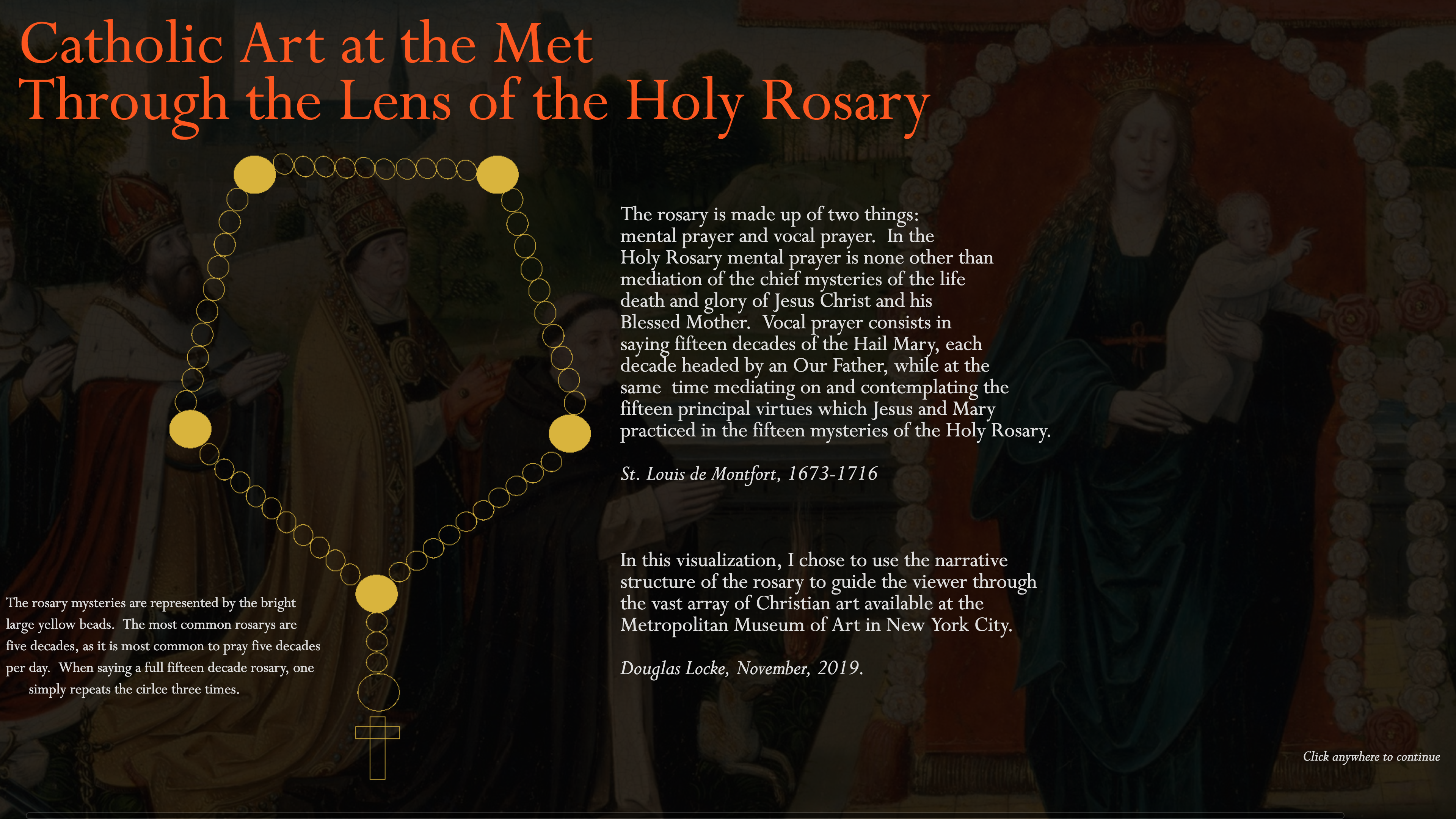
For the interactive portion of the project, I chose to revisit my quantitative analysis. I introduced a new title page and explanatory material. |
|
I also introduce a new filtering menu and a rollover effect, which highlights the mystery and presents more information. |
|
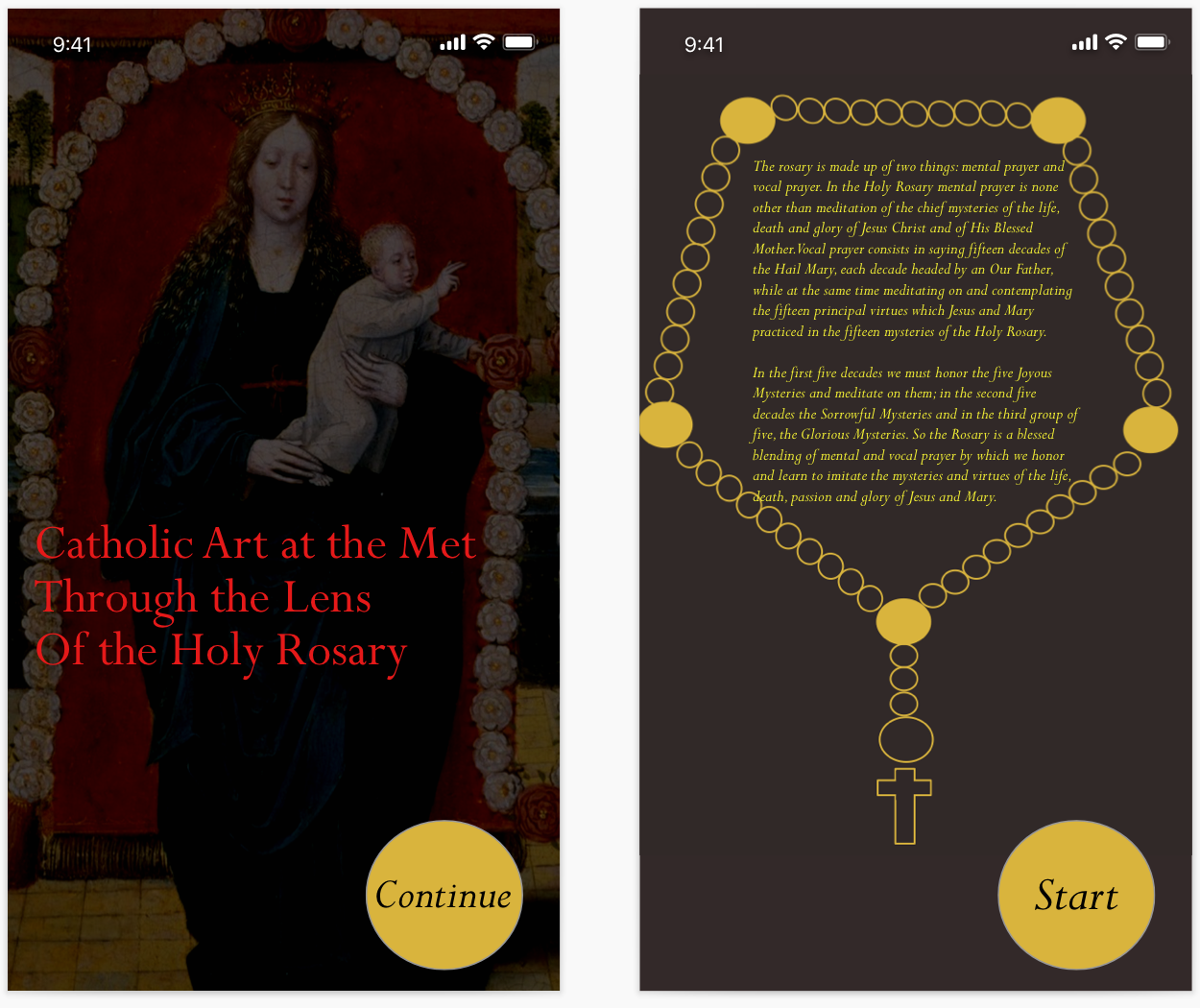
Here I designed and built a responsive mobile version of the site, with new title and explanatory pages. |
|
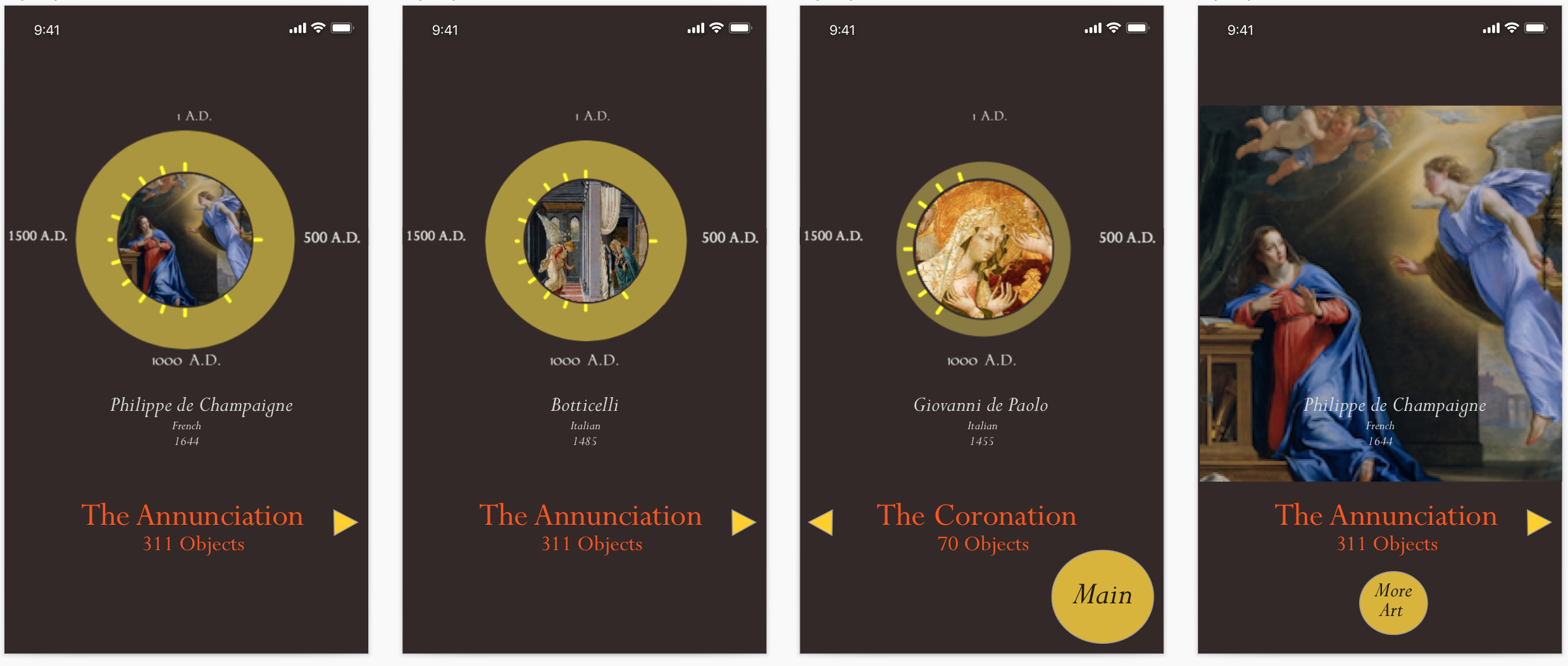
I experimented with various designs based on my original. From left to right we see 1) A conventional design showing 1 mystery at time, retaining the quantity of the number of objects found at the Met museum related to the mystery 2) Alternative artwork presented when touching the center 3) New mystery presented when swiping 4) An alternative design, emphasizing the art and losing the ring motif. |
|
The initial version has an experimental mode, effectively animating the original design, and stepping through each mystery on each swipe. The mobile device becomes a lens to view the original desktop version. Ultimately this animated design fails to utilize the strengths of the mobile platform, but it is novel to see the result: |
|
Visualization: P5.js / Vibrant.js / HTML / Sketch Data Analysis: Python, Node.js, Tableau |
|
Refine "center of the ring" in desktop version. Make all filters work & connect with data. Additional filter for object materials (paintings, glass, sketches, sculpture). Include if objects are currently on view, and location. Consider fully embracing mobile, and add a stepper to include all rosary prayers. |